 blog
blog
HSB Tile vs All Style Tile: Which Tile Is Right for You?
Table of Contents
- Understanding the hsbtile vs all style tile Comparison
- What Sets These Two Tile Brands Apart
- Tile Substrate Preparation Requirements for Each Brand
- Custom Shower Waterproofing Methods That Work With Both Brands
- Managing Lippage in Custom Tile Work
- Professional Tile Installation Services: What to Expect
- Cost and Durability: hsbtile vs all style tile in Real Projects
- Frequently Asked Questions
Last Updated: September 26, 2026
Understanding the hsbtile vs all style tile Comparison
The hsbtile vs all style tile question comes up often for Treasure Valley homeowners, and the honest answer is that it is not really about two brands. At RTS Remodel, we install tile and stone across Boise, Meridian, Eagle, Star, and Kuna, and the failures we get called to fix almost never trace back to which box the tile came out of. They trace back to what happened underneath it.
Tile is a finish material sitting on a system: prepared substrate, waterproofing, the right thinset, and a layout that accounts for movement and drainage. Get that system right and mid-grade tile performs beautifully for decades. Get it wrong and even premium tile will crack, pop, or grow mold behind the wall.
What Sets These Two Tile Brands Apart
Most tile lines differ in body type (ceramic, porcelain, or natural stone), edge style (rectified versus pressed), size and thickness, shade variation between lots, and price tier. Those differences affect how a tile cuts, how tight your grout joints can be, and how much waste to plan for.
Rectified porcelain is cut to an exact size after firing, allowing narrow grout joints and cleaner lines on large-format installation. Pressed-edge ceramic has slight dimensional variation, so it needs a wider joint. Neither is "better", they solve different problems.
What most guides miss is that these are manufacturing traits, not quality guarantees. A tile can be perfectly flat from the factory and still fail because it was set over a floor with too much deflection.
| Comparison Point | What to Check | Why It Matters |
|---|---|---|
| Body type | Ceramic, porcelain, or stone | Determines strength and water resistance |
| Edge style | Rectified or pressed | Controls how tight grout joints can be |
| Size and thickness | Actual dimensions and depth | Affects lippage risk and floor loading |
| Shade variation | V1 through V4 rating | Prevents visible lot mismatch |
| PEI wear rating | 1 through 5 | Matches tile to traffic level |
Ceramic vs. Porcelain vs. Natural Stone: The Comparison Most Guides Skip
Brand names are marketing; body type is physics. Before comparing two tile lines, know which of these three families you are looking at, because the material decides where the tile can go and how it will age.
Maintenance and Longevity by Tile Type
How long a tile floor lasts depends as much on grout and sealer as on the tile itself:
- Glazed ceramic and porcelain: Essentially maintenance-free. Damp-mop with a pH-neutral cleaner; avoid abrasive pads and acidic cleaners, which dull the glaze.
- Unglazed and matte porcelain: More slip-resistant, but the surface can hold dirt in texture. A soft brush helps in grout lines and textured fields.
- Natural stone: Plan on resealing every one to three years depending on the stone and traffic. Use a stone-specific pH-neutral cleaner; vinegar and citrus-based products will etch marble and travertine.
- Grout: Cementitious grout benefits from sealing, especially in showers and on kitchen floors. Epoxy grout resists staining better but is harder to install and less forgiving on large-format tile.
Tile Substrate Preparation Requirements for Each Brand
Substrate preparation requirements do not change from one tile brand to another. They change with tile size, thickness, and location. A 12-inch ceramic floor tile and a 24-by-48-inch porcelain wall tile demand very different floors beneath them.
Custom Shower Waterproofing Methods That Work With Both Brands
Custom shower waterproofing methods work identically regardless of tile brand. The tile is a wear surface and a drain plane, not the waterproofing. That job belongs to a bonded membrane, sheet membrane, or liquid-applied coating applied over the substrate before a single tile goes up.
- Bonded sheet membrane: a fabric-reinforced waterproof layer adhered directly to the substrate, with seams taped and sealed.
- Liquid-applied membrane: a rolled or brushed coating built up to the manufacturer's specified thickness, with reinforcing fabric at corners and changes of plane.
Managing Lippage in Custom Tile Work
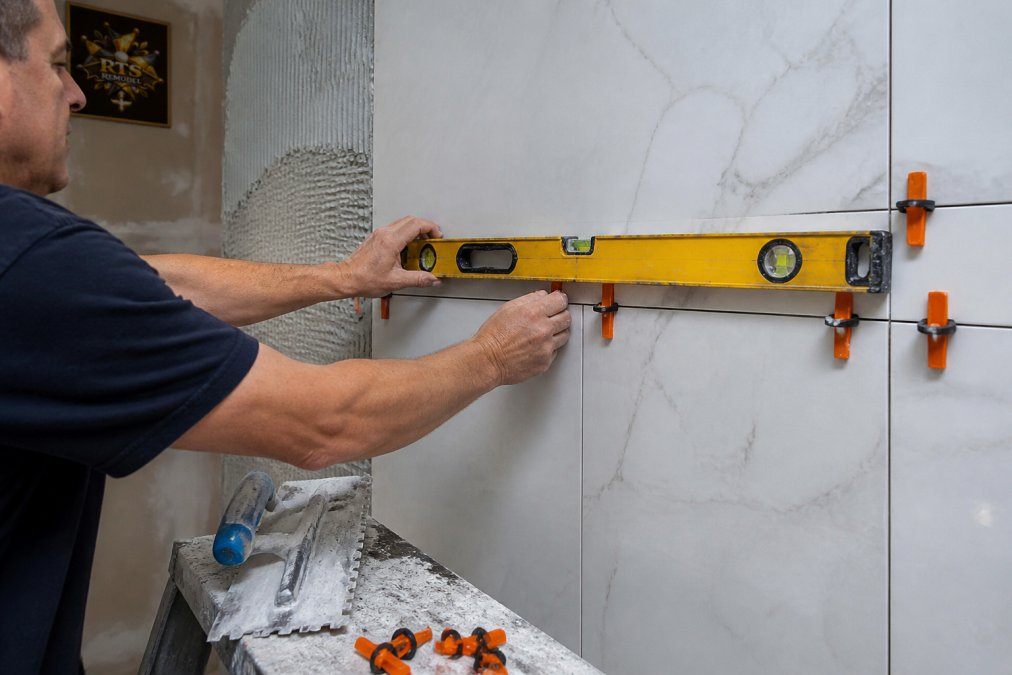
Lippage is the height difference between the edge of one tile and its neighbor. It is measured in fractions of an inch, and on large-format tile even a small variation is visible under raking light.
Professional Tile Installation Services: What to Expect
Professional tile installation should follow a predictable sequence: assessment, demolition, substrate prep, waterproofing, layout, setting, grouting, sealing, and final detailing. The visible tile is roughly the last third of the work.
Questions to Ask Before Hiring a Tile Installer
- How will you prepare and flatten the substrate?
- What waterproofing system do you use in showers, and will you flood test it?
- How do you handle layout at doorways and outside corners?
- What is your plan for dust control and protecting the rest of the house?
- How do you handle a tile that arrives with a defect or shade mismatch?
- What does your schedule look like, and how do you communicate delays?
The answers tell you more than any portfolio photo. A contractor who can explain substrate prep and waterproofing in plain language has done it many times.
Cost and Durability: hsbtile vs all style tile in Real Projects
Cost and durability in the hsbtile vs all style tile debate track almost entirely with installation quality, not brand. Tile pricing depends on material type, size, format, and layout complexity. Installation pricing depends on substrate condition, waterproofing scope, and how much cutting and detailing the design requires.
What Tile and Installation Typically Run in the Treasure Valley
Actual numbers move with substrate condition, layout complexity, and the waterproofing scope, and every house is different.
| Scope | Typical Range (installed) | Notes |
|---|---|---|
| Ceramic wall tile, simple layout | Low end of the market | Backsplashes, simple shower walls |
| Porcelain floor tile, standard layout | Mid range | Requires flat substrate and full mortar coverage |
| Large-format porcelain (24x48 and up) | Higher than standard | More prep, more handling, more waste |
| Natural stone (travertine, marble, slate) | Highest material tier | Sealing, heavier substrate support |
| Custom shower, full waterproofing | Separate scope | Membrane, flood test, pan, curb, drain |
- Larger tile usually costs more to install because it demands flatter substrates and more careful handling.
- Complex patterns, mosaics, and inlays add labor because every cut is a layout decision.
- Natural stone needs sealing and more careful substrate support than porcelain.
- Repairing failed tile costs more than installing it correctly the first time.
DIY vs. Professional Installation: An Honest Framework
Some tile work is genuinely DIY-friendly; some is not. Here is how we would sort it if a neighbor asked over the fence.
Reasonable DIY candidates:
- A small ceramic backsplash over a flat, painted wall
- A simple floor in a small powder room with a flat, stable subfloor
- Replacing a few cracked tiles where the substrate is sound
Where professional installation pays for itself:
- Any wet area, showers, tub surrounds, steam rooms. Waterproofing is a system, not a product, and the failure points (corners, curb-to-floor transitions, drain connections, fastener penetrations) are exactly the places a first-timer misses.
- Large-format tile. Lippage is measured in fractions of an inch, and without a flat substrate and a leveling system, the floor will telegraph every low spot under raking light.
- Natural stone. Sealing, layout, and substrate support all require judgment that comes from repetition.
- Heated floors. Embedding a heating mat, then setting tile over it without nicking a wire, is a sequencing problem as much as a tiling one.
- Anything with a complex pattern, mosaic, or inlay. Every cut is a layout decision, and mistakes are expensive to undo.
Frequently Asked Questions
What factors should I consider when comparing hsbtile vs all style tile?
Focus on the installation system, not just the tile surface. Ask about substrate preparation, waterproofing methods, and how the installer manages lippage. Both brands can perform well, but the quality of the subfloor, backer board, and grout application determines how long the tile lasts. Also check material durability, finish quality, and whether the tile suits your space's moisture levels. In the Treasure Valley, where temperature swings are common, proper substrate prep is critical for both brands.
How does substrate preparation affect the longevity of my tile installation?
Substrate preparation is the foundation of any lasting tile job. If the subfloor is uneven, flexes, or isn't properly sealed, tiles can crack or pop loose within a year. For showers, backer board must be installed with correct fasteners and seams taped. Waterproofing membranes should cover the entire wet area. Skipping these steps is the most common reason tile fails early, regardless of whether you choose hsbtile or all style tile.
Is there a significant difference in durability between hsbtile and all style tile?
Durability depends more on installation quality than brand. Both hsbtile and all style tile offer porcelain and ceramic options that handle daily wear well when installed correctly. The key variables are substrate rigidity, thinset coverage, grout selection, and expansion joints. A well-installed tile from either brand can last decades. A poorly installed tile, even from a premium brand, may fail in months. Prioritize installation standards over brand name.
What are the benefits of professional tile installation in custom showers?
Professional installation ensures proper waterproofing, slope for drainage, and precise tile alignment. In custom showers, a pro handles substrate prep, applies waterproofing membranes, and manages lippage so the finished surface is flat and safe. They also know how to handle transitions, niches, and curved walls. DIY installs often miss hidden waterproofing steps, leading to leaks and mold. Hiring a professional protects your investment and your home.